Park AndJungle
Avery Simms
7 min
Press Esc to close

VONDER removes the camera and display from smart glasses, trading visual spectacle for memory, audio, and a frame designed to pass as ordinary eyewear.
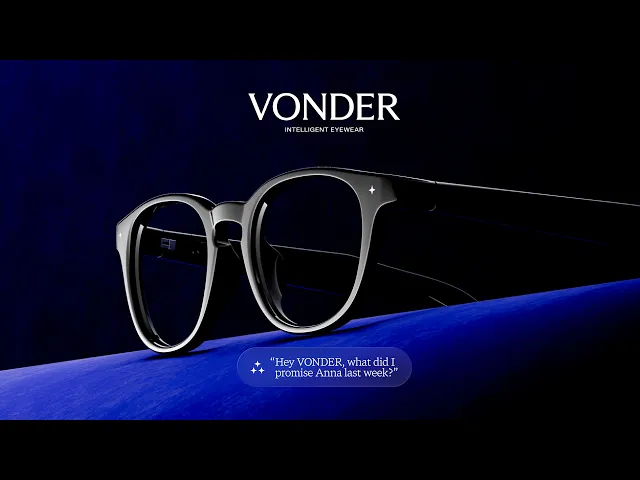
The most important feature in VONDER’s new intelligent eyewear may be what the glasses cannot do. They do not record video. They do not place a display in front of the wearer’s eyes. They do not rely on visible gestures. Instead, VONDER is building its first collection around microphones, speakers, voice interaction, contextual artificial intelligence, and a personal memory system inside acetate frames intended to look like eyewear rather than equipment.
That makes the company’s debut more than another smart-glasses launch. Cameras have given products such as Ray-Ban Meta an obvious consumer purpose, but they have also made privacy part of every interaction. A person standing across from camera-equipped glasses has to decide whether the device is recording, regardless of what its owner intends. VONDER removes that ambiguity by removing the camera. It sacrifices photography, video, object recognition, and visual AI in exchange for a device that may be easier to wear around other people.
The collection was announced in October 2026 by a team connected to VITURE, the XR-glasses company. VONDER says its initial line includes six hand-finished acetate frame styles, prescription support, a weight below 30 grams, spatial audio, voice controls, and battery life rated at up to 16 hours. Pricing begins at $299, although models and lens configurations vary. The glasses were announced for Best Buy availability, and current product pages describe preorder purchasing. These are manufacturer specifications, not Park AndJungle test results.
VONDER’s central software idea is a Personal Memory Graph. The company says users can capture notes and meetings intentionally, then ask the glasses questions grounded in that stored context. The microphone is not described as continuously recording; meeting capture is started and stopped by the wearer. That distinction is important, but it does not eliminate privacy questions. Buyers still need plain answers about where recordings and transcripts are processed, how long information is stored, whether it trains models, how deletion works, and what features remain functional without a subscription.
The subscription question is especially significant. VONDER’s hardware can function as audio eyewear, but independent launch reporting indicates that its assistant and memory features require a paid Starter or Pro plan. Public pricing for those plans was not clearly available at the time of this review. That means the real cost of ownership cannot be reduced to the frame price. Prescription lenses, replacement or specialized lenses, and recurring software fees may materially change the purchase. Until those costs are explicit, the $299 entry point is only part of the decision.
The design argument is more immediately convincing. Smart glasses will not become ordinary if they remain visibly technological or physically uncomfortable. VONDER begins with recognizable frame shapes named after cities such as Basel, Antwerp, Oslo, Paris, Palermo, and Tribeca. Product pages describe hand-finished acetate and multiple lens options, while the absence of a camera and display helps reduce weight and visual complexity. Android Central’s early hands-on coverage also found the camera-free approach meaningful for privacy and described a charging cable that can power the glasses while they are worn.
The tradeoff is that VONDER is closer to intelligent audio eyewear than augmented reality. There is no visual navigation, floating text, viewfinder, or heads-up display. The glasses cannot capture the scene in front of the wearer for later recall. Their usefulness depends on whether voice interaction, audio, and deliberate memory capture solve enough recurring problems to justify wearing and charging another device. For someone who wants private audio, meeting notes, reminders, and hands-free access to contextual information, that may be enough. For someone expecting a replacement for a camera, phone screen, or spatial computer, it will not be.
There is also a social question beneath the specifications. Technology worn on the face affects everyone in the room, not only its owner. The first generation of smart glasses often treated that external discomfort as a communications problem. VONDER treats it as a product constraint. Removing the camera is not merely a privacy statement; it changes what the product is allowed to become.
That narrower ambition may ultimately be its strength. The next successful wearable may not be the device with the most visible capabilities. It may be the one that creates the least friction between the wearer, the people nearby, and the technology itself. VONDER still has to prove its software, subscription value, comfort, microphone performance, and privacy controls in daily use. But it asks the right design question: what if smart glasses became more acceptable by trying to do less?
Press Esc to close
Park AndJungle
Want to join the conversation?
The products, observations, and ideas we publish are informed by hundreds of hours spent talking with clients each year. If you'd like us to share your brand with our community, we'd love to learn more about what you're building.

atlas

1hr



field
8hr

cure
6hr

uninterrupted
6hr

bevel
7hr


